Review · BARCELONA
Barcelona Side Streets Tapas & Wine Tour
Barcelona’s best food stories often come in small portions. This tour links four food stops with the old lanes of the Gothic Quarter, El Born, and Barceloneta, so you get more than a parade of plates. You sip white wine from a traditional porrón, try Basque vermut, eat Catalan Fideuà, and finish with a regional pastry.
I like the small group of up to 12 people, which gives you room to ask questions without shouting across a table. I also like the route itself: it connects churches, medieval alleys, the old market area, and the waterfront while showing how local food grew from ordinary neighborhood cooking.
The main caution is value. At $114.93 per person, the food and drinks may feel modest if you expect a full dinner or high-end tasting menu. Several diners praised guides such as Sky and Lindsay, but some found the portions and food quality too limited for the price. Wear comfortable shoes, too.
Key things to know before booking
- The tour crosses three old Barcelona districts: You begin near La Mercè, walk through El Born, and finish in Barceloneta.
- Fideuà replaces the usual rice paella: This Catalan noodle dish comes with alioli and a glass of Cava.
- The drinks are part of the lesson: You taste white wine from a porrón, a Basque-style vermut cocktail, and Cava.
- The guide makes a big difference: Sky and Lindsay have received especially warm praise for their city knowledge, energy, and storytelling.
- The price covers food and listed drinks: Extra drinks are not included, and the portions may suit a generous tasting rather than a complete evening meal.
- Dietary limits matter: Vegetarian and gluten-free diets can be accommodated, but vegan diets cannot.
Starting at Plaça de la Mercè
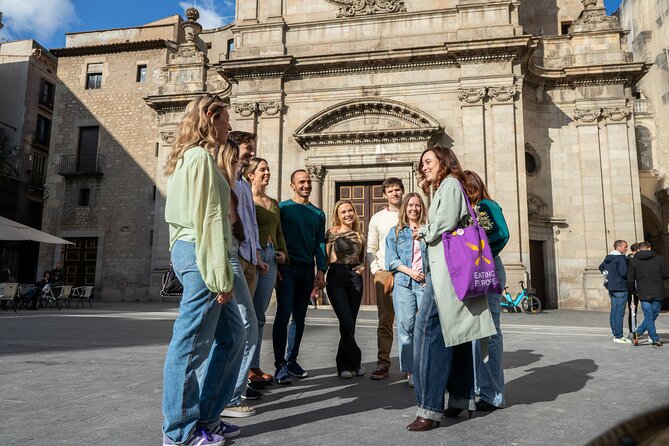
The tour begins at Plaça de la Mercè in Ciutat Vella, a useful meeting point near the Gothic Quarter. The square is home to the Baroque Basilica de la Mercè, dedicated to Barcelona’s patron saint, and it puts you close to several of the city’s oldest streets.
This is not simply a place to gather and rush away. The basilica gives your guide an early chance to explain Barcelona’s religious and civic past before the eating starts. The tour also points out that the basilica contains a medieval Madonna and shows two different building periods.
You finish at Plaça de la Barceloneta, so the route is one-way rather than a loop. That matters when planning your evening. You will not return to the starting point, and you will want to allow time for the walk back, a taxi, or public transportation after the final stop.
More Tapas and Wine Tours in Barcelona
- Montserrat Half-Day Tour with Tapas and Gourmet Wines
★ 5.0 · 7,359 reviews - Montserrat & Cogwheel Train, Gourmet Wine Tasting & Tapas/Lunch
★ 5.0 · 6,290 reviews - Barcelona Tapas and Wine Experience Small-Group Walking Tour
★ 5.0 · 5,804 reviews
First bites at Perikete
The opening food stop is Perikete, described as either an intimate bodega beside Barcelona’s 2,000-year-old wall or a lively partly outdoor bar near the port. The exact setting can vary, but the purpose is the same: begin with simple Catalan food and a traditional way of drinking wine.
Possible bites include aubergine tortilla with pa amb tomàquet, or crispy fried aubergine and mushrooms. Pa amb tomàquet is bread rubbed with tomato and usually finished with olive oil and salt. It is plain food, but it is central to Catalan eating and helps you understand why the region prizes good bread, tomatoes, and local ingredients.
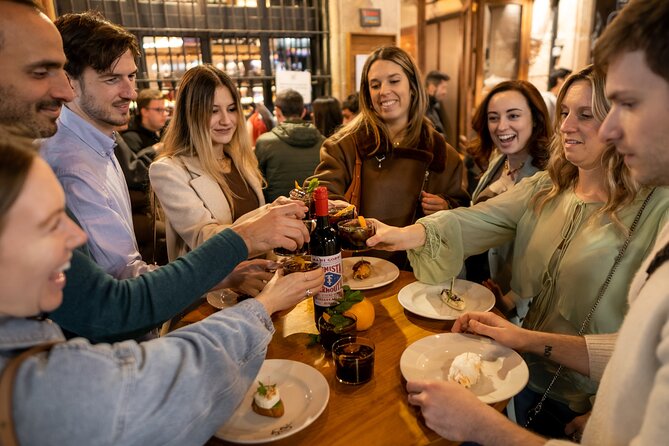
Your white wine arrives in a porrón, a glass vessel with a narrow spout. You lift it and pour the wine into your mouth without touching the spout to your lips. It is fun, but also a small piece of social dining culture. If you have never used one, your guide can help you avoid wearing the wine instead of drinking it.
This stop is a good example of the tour’s approach. You are not being sent only to polished restaurants for expensive specialties. You are tasting food with working-class roots, served in places connected to everyday Barcelona. That authenticity is a strength, but it also explains the concern about value. If you measure the price by luxury ingredients or large portions, this first stop may feel too basic.
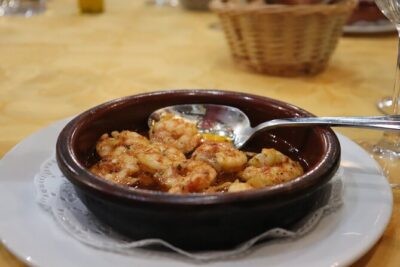
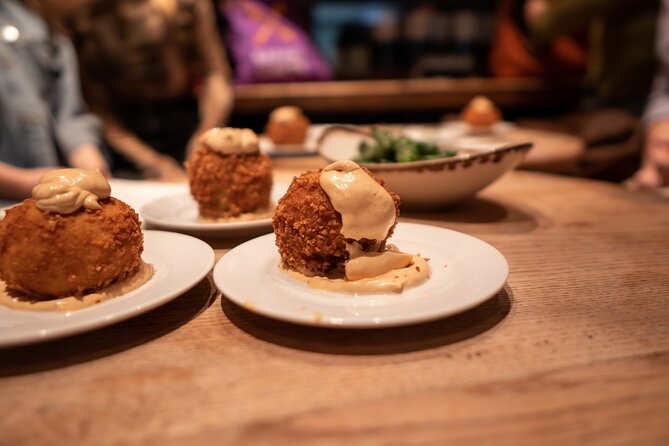
The listed food also includes the Bomba de Barceloneta, one of Barcelona’s best-known tapas. Because the exact order can vary, you should treat the meal as a tasting route rather than expect every item to arrive in a fixed restaurant-style sequence.
Pintxos and vermut in El Born
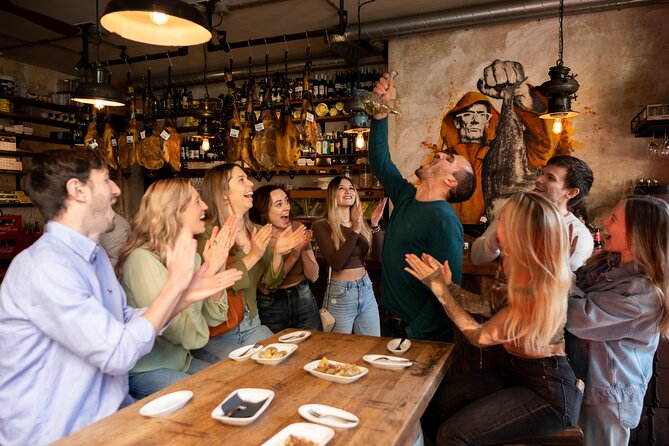
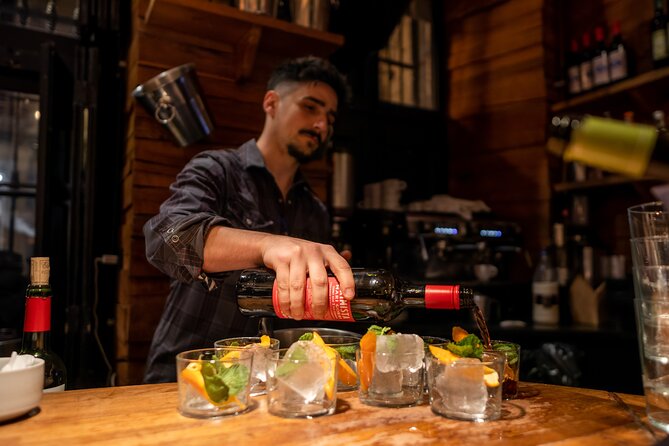
From the first stop, the route moves toward Euskal Etxea Taberna in El Born. This Basque-style bar displays pintxos, small bites often arranged on bread and held with a pick. You choose one pintxo, then pair it with a Basque-style vermut cocktail.
This stop adds a useful contrast. Catalan tapas and Basque pintxos are not the same thing, even though both are associated with small plates and social eating. The setting and serving style give your guide a natural way to explain how food traditions from different parts of Spain appear in Barcelona.
El Born is one of the best areas in the city for this kind of walking tour. Medieval lanes lead toward Passeig del Born and Santa Maria del Mar, a Gothic church built over 60 years by local people. Bricks were carried by hand from Montjuïc mountain, an old detail that makes the building feel tied to the neighborhood rather than dropped into it as a grand monument.
The 20-minute stop is brief. You will not have time to linger over a long meal, and your choice is limited to one pintxo. Still, the short format keeps the group moving and leaves room for several different food traditions during the three-and-a-half-hour tour.
Fideuà in Barceloneta’s oldest house
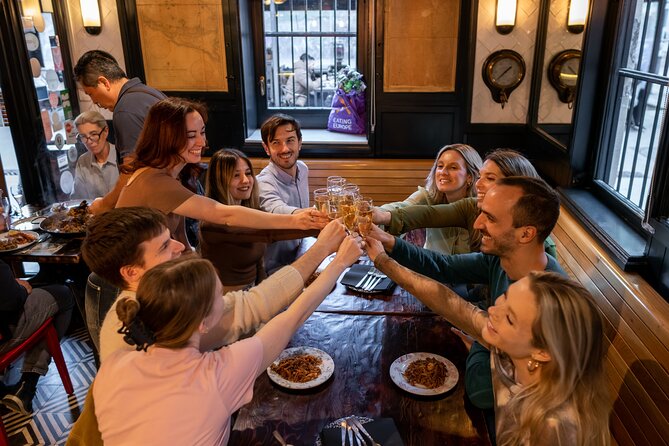
The most substantial stop is Restaurant Can Ramonet, a third-generation restaurant in what is described as the oldest house in Barceloneta, dating from the 1700s. The restaurant sources ingredients from the Barceloneta Market, tying the meal to the neighborhood’s food trade.
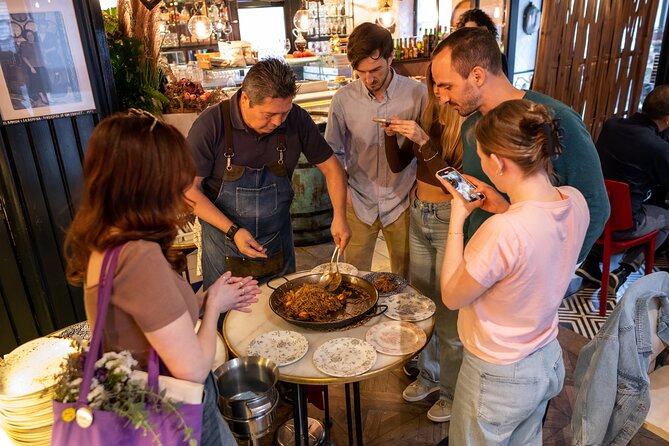
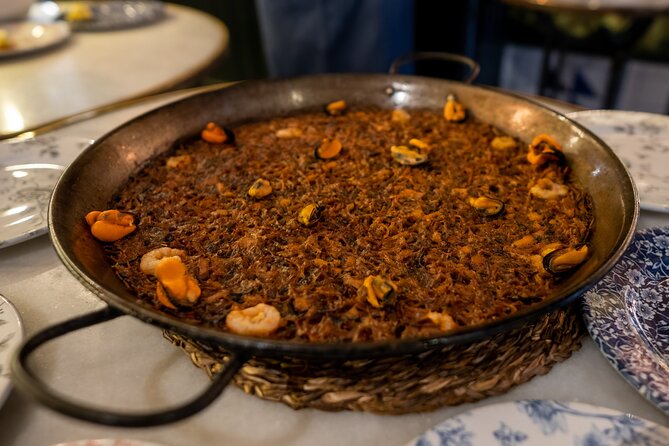
Here you eat Fideuà with alioli. Think of it as a Catalan cousin of paella, made with short noodles rather than rice. The noodles take on the flavor of the seafood and cooking stock, while the garlicky alioli adds a strong, creamy finish.
A glass of Cava accompanies the dish. This is one of the tour’s most satisfying pairings because the sparkling wine cuts through the richness of the noodles and alioli. It also gives your guide a chance to connect the meal with Catalonia’s own wine tradition.
The restaurant’s age and market connection make this more than a standard seafood stop. You are eating in a neighborhood shaped by the sea, local trade, and generations of family cooking. That context is one of the tour’s strongest features.
Still, do not mistake one shared tasting portion for a full restaurant dinner. Some diners found the overall quantity too small for the price, while others felt they received more food than expected, especially when extra stops were added. Your experience may depend on the group, the serving sizes, and the day’s food plan.
More Tapas and Wine Tours in Spain
- Montserrat with Black Madonna & Medieval Winery with Tapas/Lunch
★ 5.0 · 5,209 reviews - Barcelona: Montserrat and Winery Tour with Tapas or Lunch
★ 4.8 · 4,695 reviews - Barcelona: Tapas Walking Tour with Food, Wine, and History
★ 4.8 · 4,261 reviews - Barcelona: Food Walking Tour with Tapas and Wine
★ 4.9 · 2,180 reviews
A pastry finish at Forn de pa Balboa
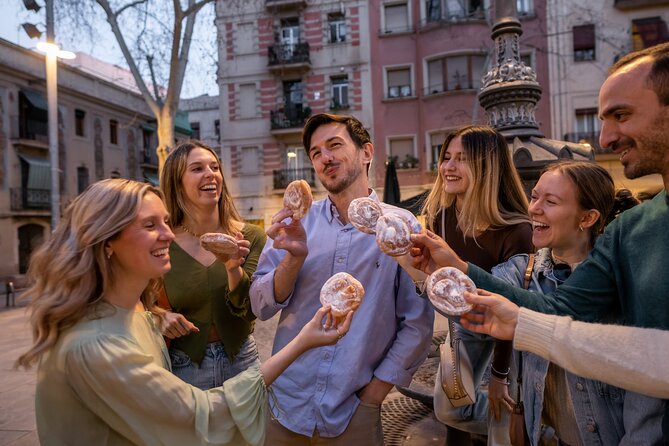
The final food stop is Forn de pa Balboa, a bakery known for supplying Catalan pastries to venues around Barcelona, or another well-loved neighborhood bakery. You finish with a traditional regional pastry.
A sweet ending is welcome after the salty tapas, fried aubergine, noodles, alioli, and drinks. It also rounds out the meal by showing that Catalan food is not only about seafood and savory plates. The pastry gives you one last local flavor before the route reaches the waterfront.
This is another short stop of about 20 minutes. You will taste one pastry rather than browse a large bakery selection. If you want a full dessert course or coffee, budget separately, since extra drinks are not included.
Walking through El Born and the Gothic Quarter
The food is only half of the experience. Between stops, your guide leads you through medieval alleys and along Passeig del Born. You pass Santa Maria del Mar, one of Barcelona’s most striking Gothic churches, and learn how its construction depended on local labor.
The route also brings you near Picasso’s first home. That gives you a worthwhile option after the tour: stay in the area and explore more of El Born rather than treating the final pastry as the end of your evening.
The tour’s cultural explanations are important here. A guide can explain why pa amb tomàquet matters, how a porrón is used, and why Fideuà belongs to Catalan food culture. A standard guidebook may list these dishes, but it usually cannot connect them to the places, customs, and people around you.
Guides Sky and Lindsay have been singled out for their friendly style, city knowledge, and ability to connect food with Barcelona’s past. Names and assignments can change, so you should not book solely on the hope of having one particular guide. Still, the repeated praise for the guides suggests that the human side of the tour is a major part of its value.
From church steps to the Barceloneta waterfront
The walking continues toward Barceloneta, where the atmosphere shifts from medieval streets to open seaside paths. You pass Marina Port Vell, the main marina, with luxury yachts and small local cruise boats.
The waterfront gives the tour a strong visual change near the end. After narrow lanes and old stone churches, you get open views, sea air, and a clearer sense of Barcelona’s coastal identity. The route also points out La Carassa, a carved face hidden in the streets, adding a small piece of local oddity to the walk.
You also see the original location of the Barceloneta market. It still serves local restaurants and remains linked to the neighborhood’s supply of fresh ingredients. This helps explain why Can Ramonet’s market sourcing matters. The restaurant is not just using a convenient marketing story. The market is part of the area’s daily food system.
The end point is Plaça de la Barceloneta. Since the tour moves through several districts and includes walking between four stops, comfortable shoes are essential. The pace has been described as manageable, but the total route is not a sit-down tasting experience with only a few steps between tables.
What the $114.93 price really covers
At $114.93, this tour costs more than simply ordering tapas on your own. You are paying for the guide, the route, the included food and drinks, the small group, and the explanations that connect each stop to Barcelona’s culture.
The included drinks are white wine from a porrón, a Basque vermut cocktail, and Cava. You also receive several savory tastings, Fideuà, a pastry, and the listed Catalan specialties. For someone who wants an organized introduction on the first night in town, that combination may be worth the extra cost.
The price is less convincing if you mainly want quantity. Some of the food is humble by design: bread with tomato, aubergine, a single pintxo, and a pastry. Those dishes can be inexpensive when ordered alone. The tour’s value comes from the explanation, the historic route, and the chance to sample several traditions without planning each stop yourself.
I would book it early if the schedule matters, since it is often reserved well ahead of time. Group discounts may be available, and the maximum group size is 12, a useful limit for conversation and quick service.
Who will enjoy this tour most
This tour suits you best if you want food paired with place and local context. It works particularly well for a first visit to Barcelona, since the route gives you an early look at the Gothic Quarter, El Born, Barceloneta, Port Vell, and the city’s food customs.
It is also a good match for solo visitors or couples who like meeting other food-focused people. The small group gives you a chance to ask questions and share the meal without the formality of a private tour.
You may want something else if you need a vegan meal, dislike walking, or expect a large dinner. Vegan diets cannot be accommodated, though vegetarian and gluten-free diets can be arranged. Service animals are allowed, and the experience is near public transportation. Most people can take part, but the total route still makes comfortable footwear a sensible choice.
Free cancellation is available up to 24 hours before the start time. If the minimum number is not reached and the tour is canceled, you are offered another date or experience, or a full refund.
Should you book the Barcelona Side Streets Tapas and Wine Tour?
Book this tour if you want an easy, well-organized introduction to Barcelona’s food culture and old neighborhoods. The best reasons are the small group, the guide’s storytelling, the varied route, and the chance to try Fideuà, pintxos, vermut, Cava, porrón wine, and Catalan pastry in one evening.
Go in with the right expectations. This is a guided tasting walk, not a lavish dinner. The portions may be enough for some people and too small for others, and the simple food is part of the point. If you value local customs and neighborhood history as much as premium ingredients, the price makes more sense. If you want a large meal for $114.93, order tapas on your own and spend the difference on extra plates.
FAQ
How long does the Barcelona Side Streets Tapas and Wine Tour last?
The tour lasts approximately 3 hours and 30 minutes.
Where does the tour start?
It starts at Plaça de la Mercè in Ciutat Vella, Barcelona.
Where does the tour finish?
It finishes at Plaça de la Barceloneta in Ciutat Vella.
What food is included?
Included tastings feature Catalan tapas such as the Bomba de Barceloneta, aubergine tortilla, pa amb tomàquet or crispy fried aubergine, Catalan Fideuà with alioli, and a traditional regional pastry.
What drinks are included?
The tour includes white wine served from a traditional porrón, a Basque-style vermut cocktail, and a glass of Cava.
Are extra drinks included?
No. Extra drinks are not included.
Can the tour accommodate vegetarian diets?
Yes. Vegetarian diets can be accommodated.
Can the tour accommodate gluten-free diets?
Yes. Gluten-free diets can be accommodated.
Can the tour accommodate vegan diets?
No. Vegan diets cannot be accommodated.
How large is the group?
The maximum group size is 12 people.
Is the tour available in English?
Yes. The tour is offered in English and includes a local English-speaking guide.
Just added to the tapas trail around Barcelona
- Barcelona: Guided Rooftop Wine Tasting – Enjoy 6 Spanish Wines★ 4.5 · 61 reviews
- Barcelona Sailing Experience: Spanish Tapas and Premium Open Bar★ 4.5 · 34 reviews
- Wine & Cava Penedes Tour: Wineries, Wine Tasting and Tapas★ 5.0 · 5 reviews
- Barcelona: Bike or eBike Tour, Top Sights & Local Insights★ 5.0 · 47 reviews
- Barcelona’s Most Terrific of Tapas Tours in the Gothic quarter★ 5.0 · 2 reviews
- Barcelona Morning Tapas Crawl by Food Tour★ 5.0 · 45 reviews
- Tapas Bike Tour Barcelona★ 5.0 · 8 reviews
- Barcelona Tapas & Wine Private Tour in Traditional Taverns★ 4.5 · 60 reviews
Tapas and Wine Tours, plate against plate.
Barcelona Tapas and Wine Experience Small-Group Walking Tour
Read our review →
Barcelona: Tapas Walking Tour with Food, Wine, and History
Read our review →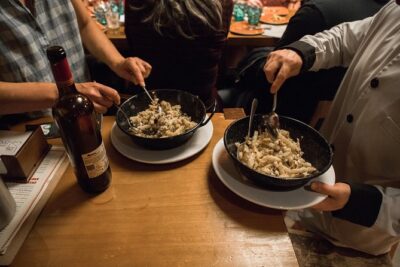
Madrid Tapas & Wine Tasting Walking Tour – Small Group Local Bars
Read our review →
Sevilla Food Tour: Tapas, Wine, History & Traditions
Read our review →
Valencia Old Town Tour with Wine & Tapas in 11th Century Historic Monument
Read our review →
Madrid: Tapas & Wine Tasting Tour with Local Guide
Read our review →
Madrid Tapas & Wine Tour with Rooftop Views and Local Guide
Read our review →